Bringing women-centred outreach to the streets
A recent article from the BBC highlighted that according to research from the charities Solace and Single Homeless Project, the number of women sleeping rough is more than 10 times the figure identified in government reports.
As national coverage spotlights the hidden experiences of homeless women, Caroline (Caz), a Homeless Outreach Nurse that received funding from the RCN Foundation (in partnership with The Grace Trust) in 2024, shows how new learning is shaping a women-centred approach to outreach.
Breaking down barriers for healthcare access
I’m always learning from others, watching what they are doing in the realm of supporting people experiencing homelessness, always questioning what more is needed, what more can be done. After reading the BBC article around homeless women on the streets, I had to smile despite the sadness of the story.
There’s a knowing when you work in this field, an understanding of the goodness of those people reaching out and giving whatever it is they can. Their warmth, humour, authenticity and drive. Most importantly, their ability to build rapport with those who have learned (quite understandably once you listen to their stories) not to trust easily. The value of presence, a non-judgmental face and kind heart cannot be quantified. For those women on the streets, whether they want help in that moment or not, the true value is in the reliability, the safe place, the sense that people genuinely care, and that they are worth being cared for. Small moments of comfort offering a short break in what is a volatile, dangerous existence.
I am in awe of those beautiful teams and individuals heading into cold, wet nights or waking up in the very early hours, putting their comfort aside to provide for others. I know the worry they bring home when they haven’t found someone they were hoping to, the sad truths, the distress and ongoing traumas they witness. I know that most people aren’t prepared to do that – and what it is in them that keeps them going: little wins.
They are women, they are already at risk just by existing. I think it is always important to remember that. They learn to survive in ways most people can’t bear to think about.
As a homeless outreach nurse, I am privy to the ups and downs of my patient’s lives. I listen to their experiences, feelings and concerns, tend to their wounds and assess their health issues, but we also laugh; it isn’t constant negativity. People experiencing homelessness are highly resilient – the banter level can be high in the same way the darkest moments are unbelievably low. They are treated as humans, individuals with worth, and they often comment on feeling listened to, calmer and more positive following engagement. That’s what I love being able to give. I can’t fix everything, but I will always meet people ‘where they are at’ and without expectations. I’m so happy when they return because this sort of nursing is a slow burn, alongside the rollercoaster of their lives. The results can be astoundingly positive – lives being completely turned around – but the reality is that it takes time, and you need to be there for each moment it doesn’t quite go to plan and be willing to start again. As many times as it takes.
Working in conjunction with other teams, we aim to support in whatever way is required and at a pace needed on an individual level. We are working with women who have multiple complex needs; where overlapping challenges may include severe mental illness, substance misuse and criminal justice involvement – often linked to adverse childhood experiences and trauma. They are incredibly vulnerable. These are women who have often experienced neglect, abandonment and abuse. Women with high rates of diagnosed and undiagnosed neurodivergence, lifelong mental health issues without support or healthy coping mechanisms in place. Healthy relationships are often an unknown concept, leaving them open to grooming, predators and violence. They are women, they are already at risk just by existing. I think it is always important to remember that. They learn to survive in ways most people can’t bear to think about.
I am a nurse, a woman, a mum
I’m currently working with a young teen, in and out of care since birth. Known to CAMHS throughout her younger life but who has dropped off the radar since turning 18 regarding support services – a common story for care leavers. She has found herself sofa surfing following breakdown of familial relationships, struggles with her mental health, physical health issues, self-harm and is neurodivergent. Her history has left her highly vulnerable to grooming, and concerns were raised about the property she had been residing at. She was practically dragged in to see me by her friend – very vocal about not wanting help and not trusting professionals. She did however require urgent medical attention and knew she needed to do something. Through gentle, trauma-informed conversation, trust-building and action with explanation, it has been possible to get her the treatment required. With advocacy and chaperoning she is now engaging in mental health support and seeking help for her chronic physical health issues. Safeguarding fell through due to her having capacity to decline, and emergency housing was difficult as she couldn’t be verified as a rough sleeper, but slowly we are getting her into a safe, supported environment. The biggest win has been her continued engagement with the service. She seeks us out; she views us as a safe place and can vocalise her needs. There is so much still left to achieve, but she is not alone and that is huge.
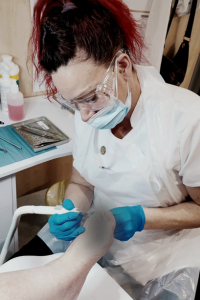
I am a nurse, a woman, a mum. I experienced adverse childhood experiences and I am neurodivergent; I have not led a straightforward life and my route into nursing has been fittingly non-linear. I have had negative experiences within healthcare due to lifestyle choices in my younger years and I still do not find it easy to ask for help. I was very lucky to have found people along my journey to support, encourage and guide me into better directions and decision-making. My life is different from the women I am working with, but I can relate. You can never truly understand what another person is experiencing, but if you know trauma and are fortunate enough to have healed or be healing from it, the skills you are gifted with can be put to great use and benefit to others. I would strongly advocate considering nursing as a profession to bring that in to.
Breaking down barriers for healthcare access is fundamental to this work. Continual advocacy to improve patient outcomes is required, and being brave enough to raise your head above the parapet to call out discrimination in healthcare policy and practice is hugely important. There are so many healthcare professionals doing amazing work in this area and those helping this patient group across all clinical settings, but better understanding is required. I would like to hope that just taking a moment to consider what a day in the life of these women entails, it might allow for a little more compassion within their care.
As I continue my journey into Tissue Viability alongside my outreach role, I hope to bring advanced wound care into the community to support marginalised health groups in accessing this healthcare need. I am involved in conversations with Local Commissioners, GP’s, outreach workers, rough sleeper teams and other professionals to start looking into options for a dedicated multidisciplinary homeless health service in our area. Homelessness rates are rising, and we need to be there to support those facing this reality, working together to improve outcomes for everybody’s benefit.